
 Secure load coverage starts with a tarp that’s sized for both the dump body and the way the system is mounted. When the tarp length doesn’t line up with the roller tube and pull bar, it can be harder to get a clean, snug fit over the box. A tarp that’s cut too short leaves little room for adjustment, while extra length can usually be taken up in the housing or rolled tight at the back of the body, as long as the system and housing are sized correctly.
Because dump truck and trailer bodies come in different lengths, heights, and styles, the goal is to match tarp size to the vehicle. Housing location and cab shield design also affect how much material you need to pull over the load.
In this tarp sizing guide for dump trucks, we’ll walk through the key measurements needed, how housing and cab shield position change the required tarp length, and practical steps you can follow to arrive at a size that gives you consistent, reliable coverage from one load to the next.
Tarp Sizing Guide for Dump Trucks
Tarps come in different sizes and weights, and the tarp size you need is not always the same as your truck or trailer bed length. The amount of tarp material needed varies with your tarp system and load coverage requirements.
In this housing position guide, we will walk you through the dump truck tarp sizing process, covering bed length, bed width, tarp system configuration, and how to identify the correct housing position to get the right fit for new and replacement tarps every time.
Here’s how to get started:
Measure the Bed Length
Start by measuring the length of the dump truck body from the front of the box to the rear tailgate. This measurement gives the base tarp length. All Pulltarps tarp systems need a tarp that’s a few feet longer than the bed length.
Measure the Bed Width
Next, measure the inside width of the box from one side wall to the other at the widest point. If the truck has sideboards or extensions above the rails, include the added height when selecting the tarp size. A tarp that does not account for sideboard height may not provide full coverage across the load area.
Matching the tarp width to the body width helps prevent gaps along the sides and keeps materials securely contained, reducing the risk of material loss or damage and compliance violations.
Housing Position Guide
The next step is to find the housing position. This is where the roller housing is bolted to the truck or trailer. The housing encloses the roller tube, and its location is used to determine the additional tarp length required beyond the bed length.
Two dump trucks with the same bed length can require different tarp lengths if the tarp systems are mounted in different locations. Systems mounted above the side rails usually need more tarp material than systems mounted lower or farther back on the body. A housing mounted farther forward or higher on the cab shield increases the distance the tarp must travel to cover the load, requiring additional tarp material.
Likewise, housing positions mounted closer to the front of the dump body, or where the tarp rolls off the top of the housing, require longer tarps than standard mounting locations.
Cab shield height also affects tarp size. Taller cab shields increase the distance from the roller housing to the front of the box and may require additional tarp length for full coverage.
Mounting positions differ between dump bodies and tarp systems, so checking the roller housing location helps match the correct tarp length to the existing system when ordering a new or replacement tarp.
Let’s look at housing position guide by tarp system type:
Automatic Tarp Systems
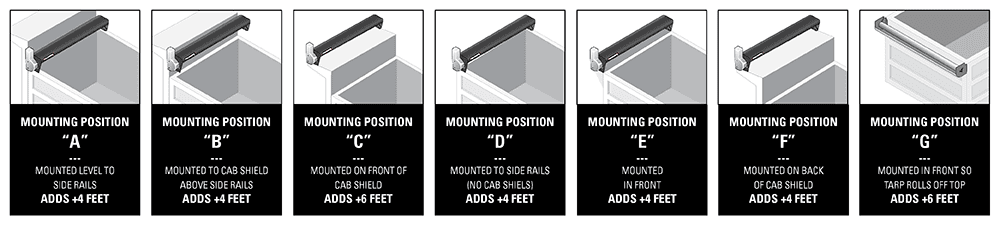
The Pulltarps Build-A-Tarp Configurator shows automatic tarp system mounting locations using housing positions A to G. Positions A, B, D and F need an additional four feet of tarp beyond the inner box length.
Position A: Mounted level with the side rails.
Position B: Mounted to the cab shield above the side rails.
Position D: Mounted to the side rails on trucks without a cab shield.
Position E: Mounted in front of the dump body.
Position F: Mounted on the back of the cab shield.
Housing positions C and G need an additional six feet of tarp because the tarp must travel before reaching the dump body.
Position C: Mounted on the front of the cab shield.
Position G: Mounted in front so the tarp rolls off the top of the housing.
When ordering a new or replacement tarp, match it to the existing housing position, not just the bed length. The Pulltarps Build-A-Tarp Configurator includes a visual housing position guide to help identify the correct housing position and additional tarp length before ordering a tarp.
Semi Automatic Tarp Systems
Semi-automatic tarp systems use the same housing position guide as automatic systems but require less additional tarp material. Positions A, B, D, and F need an additional two feet of tarp.
Position A: Mounted level with the side rails.
Position B: Mounted to the cab shield above the side rails.
Position D: Mounted to the side rails on trucks without a cab shield.
Position E: Mounted in front of the dump body.
Position F: Mounted on the back of the cab shield.
Housing positions C and G require an additional 4 feet of tarp because the housing is mounted farther forward or lower on the truck, increasing the distance the tarp must travel before covering the load.
Position C: Mounted on the front of the cab shield.
Position G: Mounted in front so the tarp rolls off the top of the housing.
Pulltarps also offers universal fit tarps (Industry Standard Fit Replacement tarps) designed to fit most competitors’ truck and trailer tarp systems and truck boxes from 10 feet to 18 feet long. These are standard-size tarps suitable for most automatic, semi-automatic, or manual systems. They’re a good option when the tarp size or system details are unknown and measurements are needed to match the correct replacement.
Get the Right Tarp Size for Reliable Load Coverage
Protect payloads with a tarp sized to match your dump truck body, tarp system, and hauling application. Accurate measurements and the correct housing position help match the right tarp size and tarp length to your truck, reducing sizing errors and helping keep loads securely covered on every haul.
If you need a complete tarp system, Pulltarps also offers a Build Your Tarp System Configurator that helps match automatic and semi-automatic tarp systems to your truck, trailer, and hauling application.